
240mm vs 280mm vs 360mm AIO: Which Radiator Size Do You Actually Need?
A 280mm radiator has 36% more surface area than a 240mm and comes within 10% of a 360mm. Here is how AIO sizes actually compare, which CPUs need which, and why case support usually makes the decision for you.
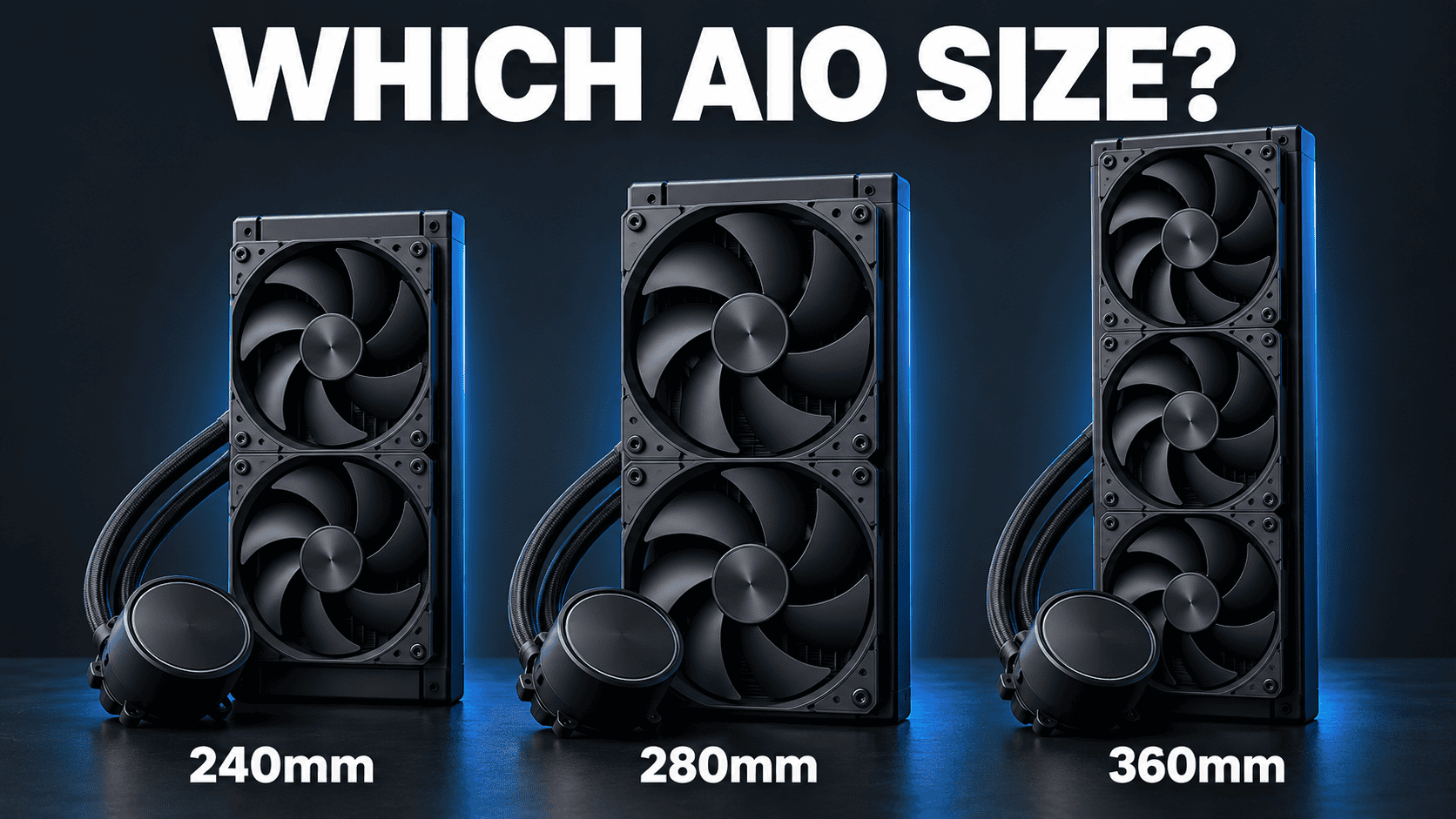
AIO liquid coolers are sold by radiator length, and the assumption is simple: bigger number, better cooling. That is broadly true, but the gaps between sizes are not even, and the size that is “best” on a chart is often not the one that fits your case or suits your CPU.
What the numbers mean
The size refers to the total length of the fans mounted on the radiator. A 240mm AIO carries two 120mm fans, a 280mm carries two 140mm fans, a 360mm carries three 120mm fans, and a 420mm carries three 140mm fans. The pump, cold plate and tubing are usually identical across sizes within the same product line. What changes is how much radiator there is to dump heat into the air.
Surface area: the comparison that matters
Working from fan dimensions alone, the radiator face area looks like this:
| AIO size | Fans | Approx. face area | vs 240mm |
|---|---|---|---|
| 240mm | 2 x 120mm | 288 cm² | — |
| 280mm | 2 x 140mm | 392 cm² | +36% |
| 360mm | 3 x 120mm | 432 cm² | +50% |
| 420mm | 3 x 140mm | 588 cm² | +104% |
The detail most people miss is how close a 280mm sits to a 360mm: the 360mm has only about 10% more face area. A 280mm is not a slightly bigger 240mm. It is much nearer to a 360mm that happens to be shorter and wider.
Why 280mm is often the quiet option
A 140mm fan sweeps more area than a 120mm fan, so it can move a similar volume of air at a lower RPM. Lower RPM generally means less noise. That is why a 280mm AIO can hold its own against a 360mm at matched noise levels even though it has slightly less radiator. It also has two fans rather than three, which means one fewer cable and one fewer bearing to wear out.
How much cooling does your CPU actually need?
Radiator size only matters if the CPU produces enough heat to use it. Gaming rarely loads every core, so gaming temperatures are far less demanding than a render or stress test.
- Ryzen 5 9600X and Ryzen 7 9700X (65W TDP): a 240mm AIO is more than enough, and so is a decent tower air cooler.
- Ryzen 7 9800X3D (120W TDP): a 240mm or 280mm handles it comfortably. A 360mm buys lower fan noise rather than meaningfully more performance.
- Ryzen 9 9950X (170W TDP) and Core Ultra 9 285K (up to 250W): this is where 280mm and 360mm units earn their place, especially if you run long all-core workloads such as rendering or code compilation.
A larger radiator will not make a game run faster. What it gives you is the same temperature at a lower fan speed, or more headroom when all cores are working flat out.
Case compatibility usually makes the decision
This is the part that catches builders out. 360mm support is common in mid-tower cases because it uses standard 120mm fan mounts. 280mm needs 140mm mounts and a wider radiator, and many cases that list 360mm support at the top do not have the width or motherboard clearance for a 280mm. Compact and Mini-ITX cases often stop at 240mm.
Before buying, check three figures on the case specification page: the supported radiator sizes for each position (top, front, side), the maximum radiator plus fan thickness, and the RAM height clearance for top mounting. A standard AIO radiator is around 27mm thick and the fans add 25mm, so you need roughly 52mm of space before tubing and fittings.
Which size should you buy?
- 240mm: small cases, and any 65W to 120W CPU where you want an AIO for looks or clearance rather than raw cooling.
- 280mm: the best balance if your case supports it. Near-360mm cooling, fewer fans, usually quieter.
- 360mm: the safe default for high-end CPUs, simply because almost every mid-tower fits one.
- 420mm: only worth it for the hottest CPUs under sustained load, and only in the few large cases that take it.
If you are still deciding between liquid and air, our CPU cooler guide covers both, and the AIO roundup lists current picks at each size. Whichever you choose, the case fans feeding the radiator matter too — see how many case fans you actually need.
Frequently asked questions
Is a 280mm AIO better than a 360mm?
Not in outright capacity — a 360mm has about 10% more radiator area. But at the same noise level the two are close, because 140mm fans move air more quietly. If your case fits both, pick on price, noise and fit.
Is a 240mm AIO enough for a Ryzen 7 9800X3D?
Yes. The 9800X3D is a 120W TDP chip and gaming does not load it fully. A 240mm AIO or a good dual-tower air cooler will keep it well within limits.
Does a bigger AIO increase FPS?
No, unless your current cooler is so inadequate that the CPU is thermal throttling. Beyond that point, a bigger radiator lowers temperatures and noise, not frame times.
The shortlist, monthly
What changed, what dropped in price, and what we would buy now. No spam.


Leave a comment